
A practical guide for site managers, facilities teams and commercial operators across London and the South East.
If you manage a car park, petrol station, vehicle depot, industrial unit or construction compound, your site may need an oil interceptor. If you already have one, it also needs regular emptying and maintenance to keep it working as intended.
Oil interceptors are an important part of commercial drainage and environmental compliance, but they’re easy to miss until a site inspection or a drainage problem brings them to the top of the list.
In this guide, we’ll explain what an oil interceptor does, when you typically need one, what the legal duties look like, and how to keep your system compliant.
What is an oil interceptor?
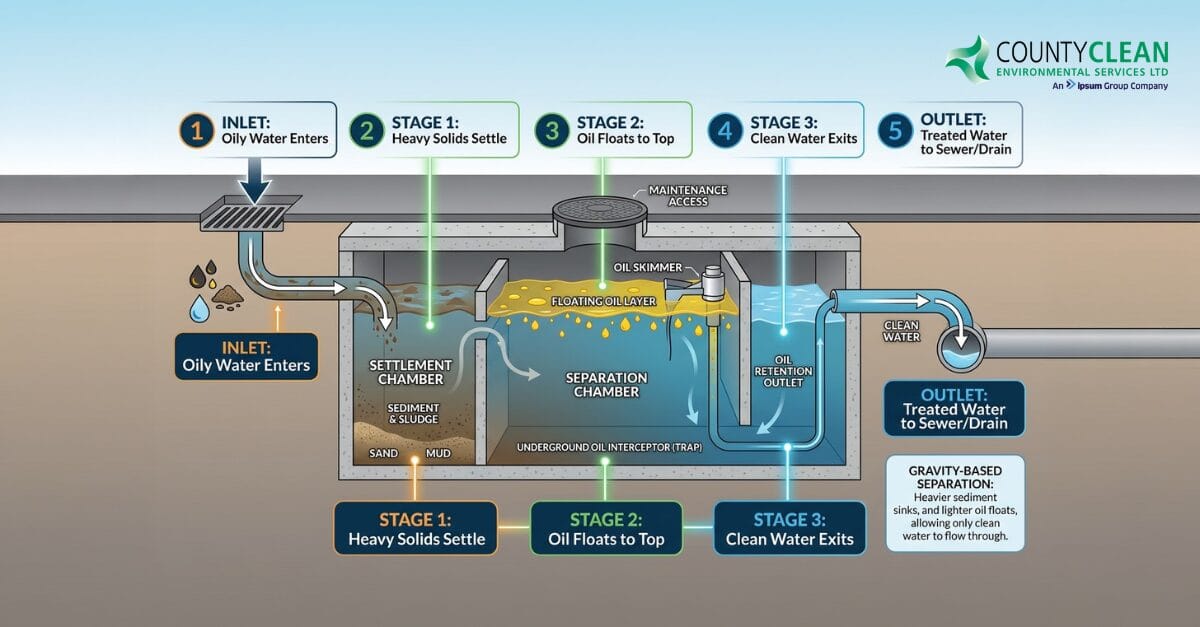
An oil interceptor (also called an oil separator) is an underground chamber fitted into a drainage system. It’s designed to stop oil, petrol, diesel and other hydrocarbons from entering the public sewer or a local watercourse.
When rainwater runs off a car park, forecourt or vehicle maintenance area, it can pick up small traces of oil and fuel. Without an interceptor, that contamination can flow into the drainage network, putting waterways at risk and leaving your business exposed if you breach environmental rules.
Interceptors slow the flow so separation can take place: water passes through while lighter hydrocarbons rise and collect at the surface. The stored oil is then removed during scheduled servicing using a vacuum tanker.
Good to Know
Discharging oily water to a public sewer or watercourse without consent can be an offence under the Water Resources Act 1991 and the Environmental Permitting Regulations 2016. Penalties can include unlimited fines and prosecution.
What types of oil interceptor are there?
Most commercial sites use one of two main interceptor types:
Bypass interceptors
Designed for lower-to-moderate oil risk areas, bypass interceptors treat flows up to a set rate and allow higher flows to bypass to prevent flooding and surcharging. They’re commonly used for car parks and many forecourt and vehicle access areas.
Full retention interceptors
Full retention interceptors treat the full flow, retaining contaminated runoff for separation regardless of the flow rate. They’re typically specified for higher-risk sites such as bulk fuel storage areas or locations handling hazardous hydrocarbons.
Interceptors also vary by construction. Brick-built chambers, precast concrete units and modern high-density polyethylene (HDPE) tanks are all used across the UK. The right option depends on site conditions, flow volumes and what contaminants may be present in the runoff.
Does your site need one?
If surface water from your site could carry oil or fuel into a drain, an interceptor is likely to be required. The exact requirement depends on your site use, where your drainage discharges to, and any consents already in place.
Sites that commonly need an oil interceptor include:
- Car parks with 50 or more spaces (or smaller car parks that drain into a watercourse or soakaway)
- Petrol station forecourts
- Vehicle maintenance workshops and MOT centres
- Lorry parks and HGV depots
- Bus and coach garages
- Airport ground handling areas
- Industrial sites storing or using oils, solvents or fuels
- Construction compounds and welfare facilities
- Rail sidings and depots
In most cases, the key factor is where your drainage discharges: to a controlled water (such as a river, stream, lake or groundwater) or to a public sewer. Your local water company and the Environment Agency can help confirm what applies to your site.
CountyClean can carry out a drainage assessment to confirm your compliance obligations and recommend the right interceptor specification for your site. Call us on 01323 741 818 or complete an enquiry form.
What are the legal requirements?
Oil interceptors for commercial sites in England are typically informed by:
- The Water Resources Act 1991 – prohibits causing or knowingly permitting water pollution
- The Environmental Permitting (England and Wales) Regulations 2016 – regulates discharges to controlled waters
- Building Regulations Approved Document H – drainage design requirements for new builds and major alterations
- BS EN 858 – performance requirements for oil separators
- PPG3 (Pollution Prevention Guidance Note 3) – guidance on oil storage and drainage for commercial sites
In practice, this usually means:
- New car park or forecourt developments will often include an interceptor as part of planning and Building Regulations compliance
- Existing sites may need to retrofit an interceptor if drainage routes change or a pollution risk is identified
- If you operate under an Environmental Permit, interceptor maintenance is often a permit condition
How often do oil interceptors need to be serviced?
How often an interceptor needs emptying depends on how your site is used and how much oil is likely to enter the drainage system. What matters is keeping enough capacity for separation to work properly—if an interceptor is left full, it can stop protecting your drains and the environment.
Common signs your interceptor may need attention include:
- A visible oily sheen on the surface water draining from the site.
- Odours coming from drains or nearby watercourses
- Pollution appearing in a nearby stream, ditch or drainage channel
- Blocked or overflowing drainage onsite
If you suspect a problem, act quickly. The Environment Agency can issue enforcement notices and may prosecute where pollution is ongoing. In serious cases, directors can be held personally liable.
CountyClean provides emergency interceptor inspection, emptying and repair services—24 hours a day, 7 days a week. If you’re dealing with a suspected pollution incident, call us straight away and we’ll talk you through the next steps.
Can CountyClean install a new oil interceptor?
Yes. Alongside emptying, servicing and maintaining existing interceptors, CountyClean delivers full oil interceptor and separator installations for commercial sites across London and the South.
Our installation service includes:
- Site survey and drainage assessment
- Specification of the right interceptor type and size to meet BS EN 858
- Groundworks and civil engineering
- Connection into existing drainage infrastructure
- Commissioning and compliance documentation
We work closely with site managers, facilities teams, developers and planning consultants to keep projects on time, on budget and compliant with the relevant requirements.
Summary: what you need to know
- An oil interceptor helps prevent hydrocarbons from reaching the public sewer or local watercourse
- Many commercial sites with vehicle movements, fuel handling or industrial drainage need an interceptor as part of their compliance approach
- If an interceptor isn’t maintained, it can fail—and that can lead to enforcement action, fines and prosecution
- Interceptors should be inspected at least annually and emptied based on site activity levels
- CountyClean can support you with installation, planned maintenance and 24/7 emergency response across London and the South