
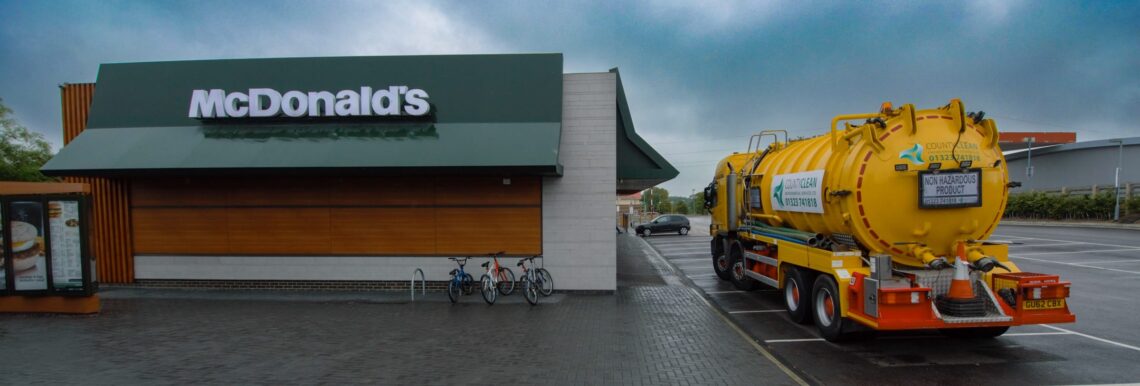
CountyClean provides professional grease trap emptying and grease trap cleaning for restaurants, hotels, food manufacturers, schools, hospitals and commercial kitchens across London and South East.
Our vacuum tankers remove fat, oil and grease (GOG) safely and efficiently with every collection being disposed at a licensed facility with a full waste transfer note. Your business stays compliant and your kitchen can keep running.
Looking for Installations?
Explore our extensive services for grease trap installations or replacements
Why kitchens across London & the South East Choose CountyClean:
- 24/7 Emergency response
- Waste transfer note with every visit
- ISO 9001, 14001 & 45001 accredited
- Fixed, transparent quotes
- Licensed disposal, fully compliant
- Planned maintenance contracts available
What Does a Grease Trap Do?
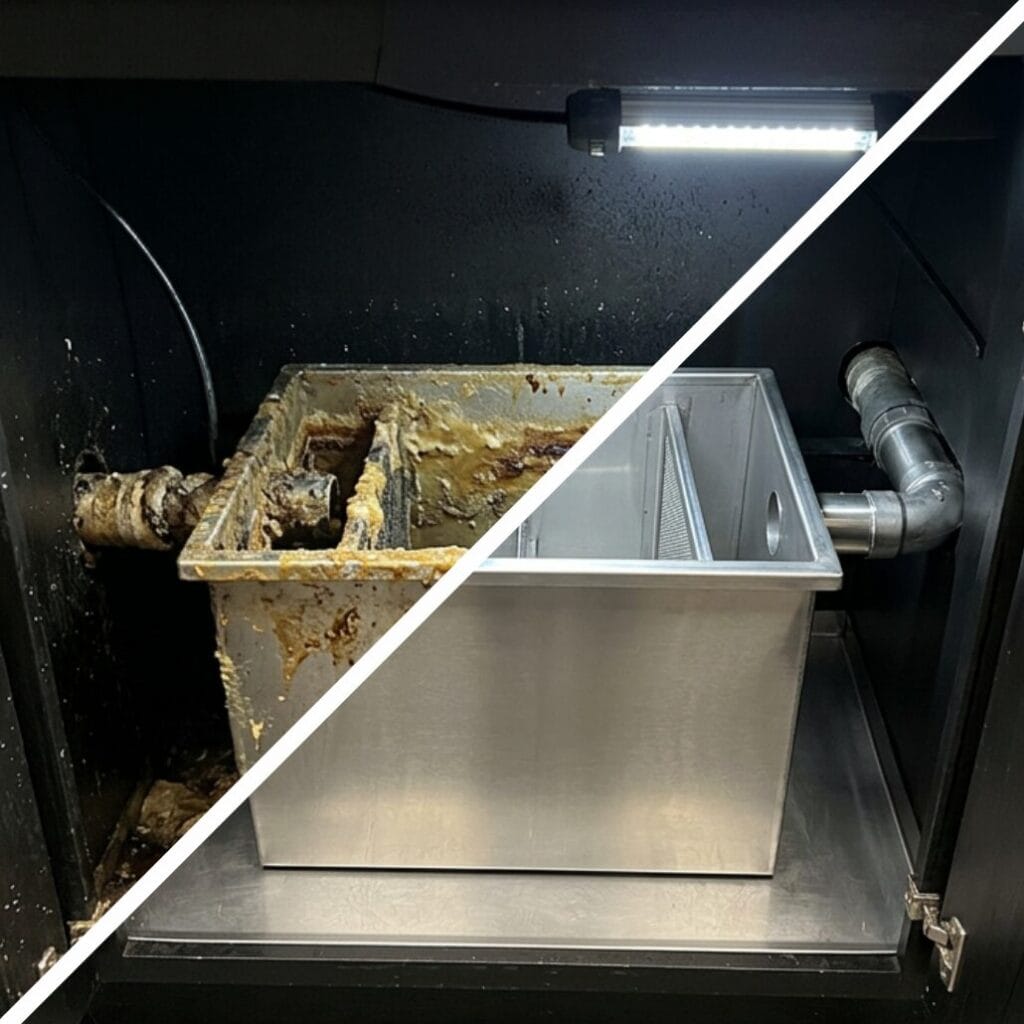
Grease traps (also known as fat traps or grease separators) capture fat, oil and grease before it enters the drainage system. Without regular emptying, the FOG builds up, hardens and solidifies and causes the grease trap to stop working which can lead to blockages, foul odours from the drains and waste backing up into the commercial or industrial kitchen.
The legal side: your duty of care
Grease trap maintenance isn’t just good housekeeping, it’s a legal requirement for your kitchen. Under the Water Industry Act 1991, discharging FOG that interferes with the free flow of wastewater is an offence and water companies can recover the clean-up costs from the businesses responsible, even where a grease trap is present in a commercial kitchen but has been poorly maintained.
The Environmental Protection Act 1990 places a duty of care on every commercial premises to arrange proper collection and disposal of controlled water, including used cooking oil and fats. Under the Food Safety Act 1990, drainage problems caused by FOG build-up can result in prosecution, fines or an emergency prohibition order from Environmental Health which effectively closes down your kitchen until the problems have been fixed.
Keeping documentation matters just as much as the service itself. Every CountyClean grease trap empty comes with a waste transfer note, giving your a clear paper trail for Environmental Health visits, insurance requirements and due diligence checks.
Signs Your Grease Trap Needs Emptying
Most grease trap problems build up gradually and the early signs are easy to miss especially during a busy service. Look out for:
- Foul odours around the sink, drain or kitchen floor area
- Slow-draining sinks or water pooling under the floor drain
- Visible grease or fat on the surface of the grease trap when checked
- Gurgling drains or unusual noises from the pipework
- Flies or pests gathering near drainage points
- Overflow or backing up of waste water during service
If you’re seeing any of these, the trap has likely passed the point where it should have been emptied. As a rule of thumb, a grease trap should be emptied once it’s around 25% full of solids — waiting longer reduces its effectiveness and increases the risk of a costly emergency call-out.
How Often Should You Empty a Grease Trap?
How often you need grease trap emptying depends on the size of the trap and how much FOG your kitchen produces. Most commercial kitchens fall somewhere between monthly and quarterly:
| Kitchen Type | Typical Emptying Frequency |
|---|---|
| High-volume restaurants, fast food & takeaways | Every 4-6 weeks |
| Hotels, pubs & medium - volume kitchens | Every 6-8 weeks |
| Schools, hospitals & care homes | Every 8-12 weeks |
| Food manufacturing & processing sites | Assessed individually by volume |
Use this table as a rough guide, the right frequency for your site depends on the trap size, sink volume and ultimately how busy your kitchen is. We can help you work out the right schedule during your first visit and can set up a planned maintenance contract so your grease trap emptying service happens automatically before it becomes a problem.
Grease Trap Emptying Near Me
We operate across the South of England and London, ensuring that we can reach you wherever you are located. Whether you’re in Hampshire, Sussex, Kent, Surrey, London, or any surrounding areas, we’ve got you covered.
We operate a 24/7 emergency service, so if you experience a blockage, call us on 0800 171 2204 or 01323 741818. You will be put through to one of our team immediately who will be able to assist.
How Our Grease Trap Emptying Service Works
1, Assessment & Scheduling : We assess the size of your trap, the volume of food production in your kitchen, and the type of waste produced to recommend the right service frequency for your site. Most commercial restaurants require emptying every one to three months; high-volume operations may need monthly visits.
2. On-site service Our fully trained operatives arrive at a time that suits your operation — typically before service or on a day you specify. Using our powerful vacuum tanker fleet, we remove all accumulated FOG and solids from your grease trap thoroughly and efficiently, with minimal disruption to your kitchen.
3. High-pressure jetting (where required) Where hard grease deposits have built up in the trap or connecting pipework, we deploy high-pressure water jetting to remove blockages and restore full flow.
4. Licensed waste disposal All waste collected is transported and disposed of at our own licensed waste recycling and disposal facility or another authorised treatment site. You receive full documentation for your records — essential for demonstrating duty of care compliance.
5. Service report and next visit scheduling After every visit, we provide a service record. For customers on a managed maintenance plan, we schedule the next visit automatically so you never have to remember.
Frequently Asked Questions: Grease Trap Emptying
The standard industry guideline is that a grease trap should be emptied before the accumulated solids and FOG reach 25% of the trap’s total capacity. In practice, this means most commercial restaurant kitchens require emptying every one to three months. High-volume operations such as busy restaurants, hotel kitchens, and food manufacturers may need monthly service. Smaller canteens or low-output kitchens may manage with quarterly visits. We assess your specific setup and recommend the right frequency during your initial consultation.
An over-full grease trap stops functioning as a separator and causes the FOG to pass straight through into the drainage system, causing blockages in your own pipework and in the public sewer. This leads to drain backups, flooding, foul odours and potential kitchen closures. You also risk enforcement action from your water authority under the Water Industry Act, and fines from Environmental Health if hygiene standards are compromised.
Yes. Under Section 111 of the Water Industry Act 1991, discharging fat, oil or grease into the sewer in quantities that cause blockages is a criminal offence. Water companies operate active FOG enforcement programmes targeting food businesses, and can issue enforcement notices, require installation of grease removal equipment, or pursue prosecution. Maintaining a serviced grease trap and keeping records of emptying is the primary way to demonstrate compliance.
Industry guidance states that a grease trap must be emptied when the combined depth of floating grease and settled solids reaches 25% of the trap’s total liquid depth. Once it exceeds this level, the trap cannot separate FOG effectively and wastewater passes through contaminated. Regular scheduled emptying ensures the trap never reaches this threshold.
Yes. We operate a 24/7 emergency service across London and the South East. If your grease trap has overflowed, is causing a blockage, or is producing severe odours that are affecting your kitchen or customers, call us immediately on 0800 171 2204 or 01323 741818. A duty manager will answer and arrange a rapid response.
For a standard under-counter or small-to-medium grease trap, the process typically takes between 30 minutes and one hour. Larger underground grease separators or traps with significant hard deposit build-up requiring jetting may take longer. We always aim to work around your service times and cause minimal disruption.
Yes. Every collection is documented with a waste transfer note, and we can provide service records on request. These records are important evidence of your duty of care obligations under the Environmental Protection Act 1990 and are useful for demonstrating compliance during EHO inspections or water authority enquiries.
Yes, this is the option most of our commercial customers choose. We agree a service frequency based on your kitchen’s output, set up a rolling schedule, and send reminders ahead of each visit. You do not need to remember to book, we can manage and schedule the services for you.
We cover London and the South East, including Surrey, Kent, East Sussex, West Sussex, Hampshire and Essex. Call us on 0800 171 2204 to confirm coverage for your specific location.
Both devices perform the same function; separating fat, oil and grease from wastewater before it enters the drainage system but they differ in size and installation. Grease traps are typically smaller units installed under the sink or within the kitchen. Grease separators (also called grease interceptors) are larger underground units, usually installed outside the building. Both require regular emptying and are serviced by CountyClean.