
If your property is not connected to the mains sewer or you are planning a new build, barn conversion or rural development, a domestic sewage treatment plant is almost certainly your best option for managing wastewater legally and effectively.
This guide covers everything you need to know before you install: how sewage treatment plants work, what the law requires, how to size and site your system, what marsh Ensign range offers and what the installation process actually looks like on the ground.
The guide which has been produced jointly by CountyClean Environmental Services (part of the Ipsum group), specialist installers covering London, Kent, Sussex and the South East and Marsh Industries, manufacturers of the Ensign sewage treatment plant range, one of the most trusted off-mains drainage systems available in the UK.
Whether you are a homeowner replacing an ageing septic tank, a self-builder specifying drainage for the first time or a developer working across multiple plots, this guide will help you make the right decisions
What is a Domestic Sewage Treatment Plant?
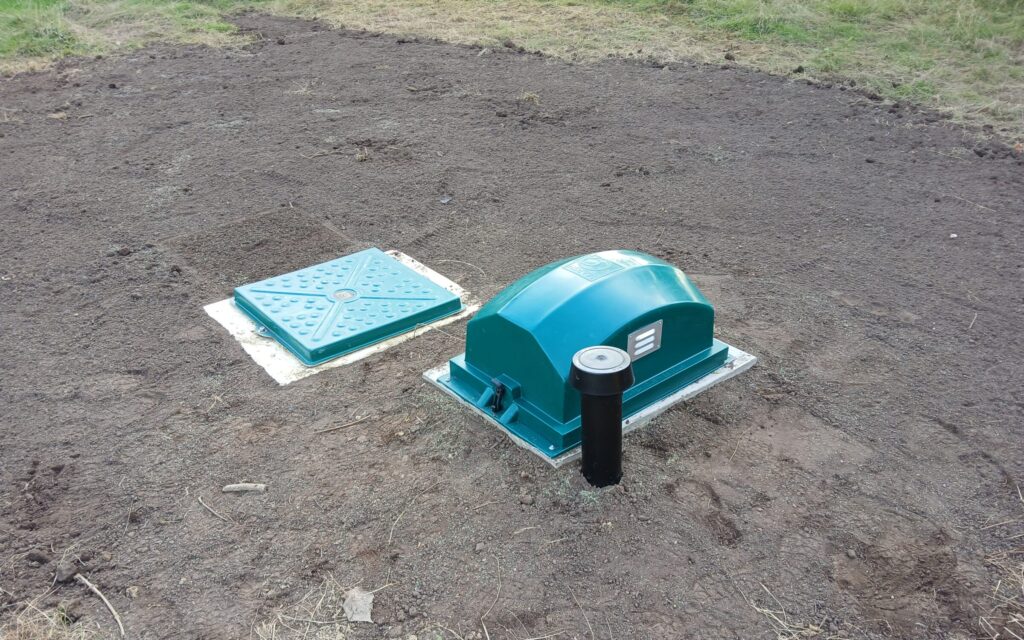
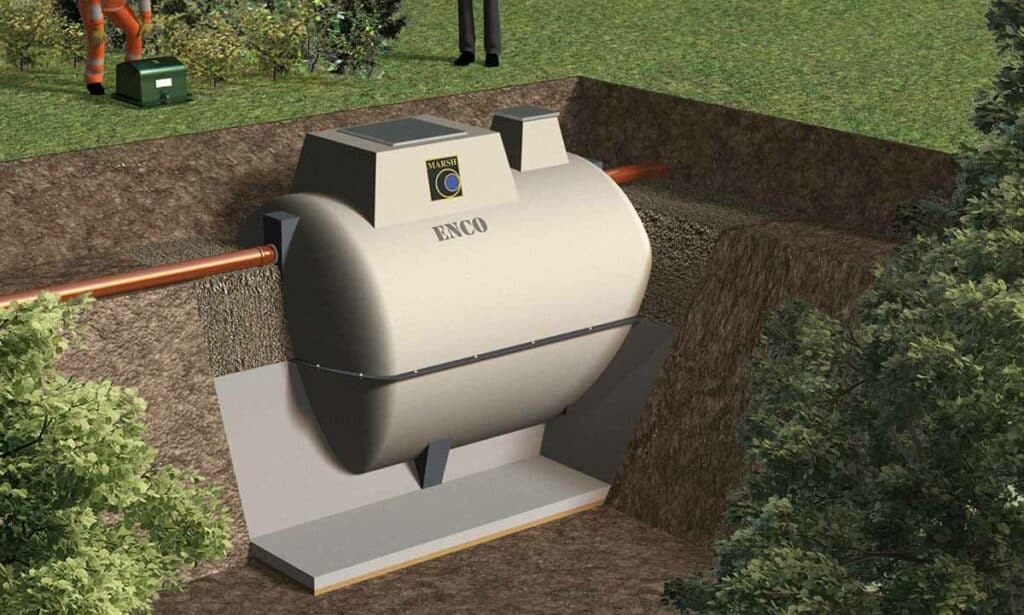
A domestic sewage treatment plant, also sometimes called a package sewage treatment plant or a package treatment plant is an underground, self-contained unit that actively treats wastewater from a property not connected to the public sewer.
Unlike a septic tank, which simply separates solids from liquid and discharges partially treated effluent, a sewage treatment plant uses biological processes to produce effluent that is clean enough to discharge directly into a watercourse, far beyond what a septic tank achieves. (subject to requirements)
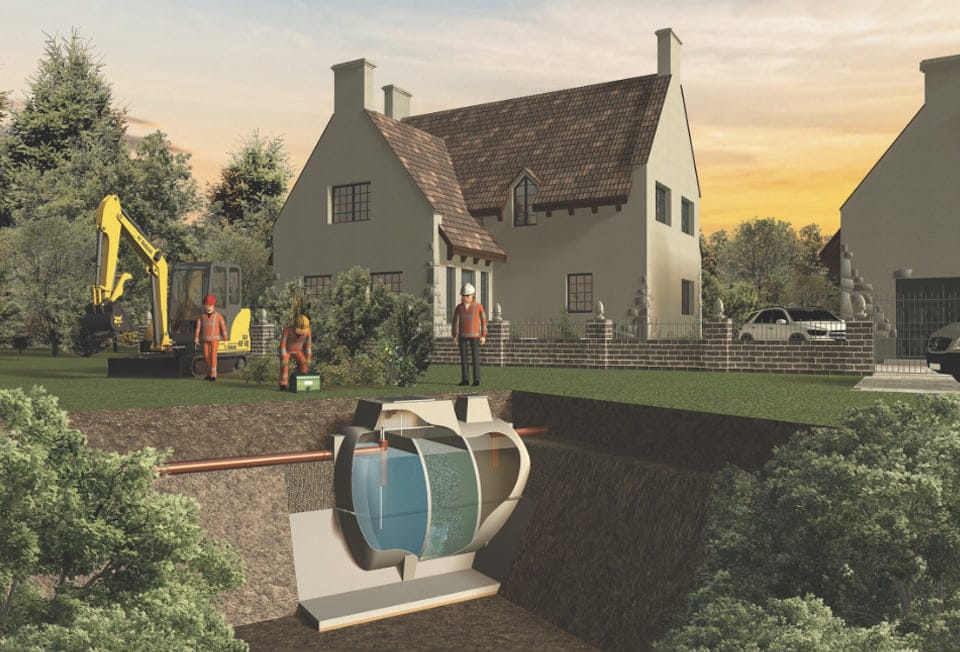
How a Sewage Treatment Plant Works
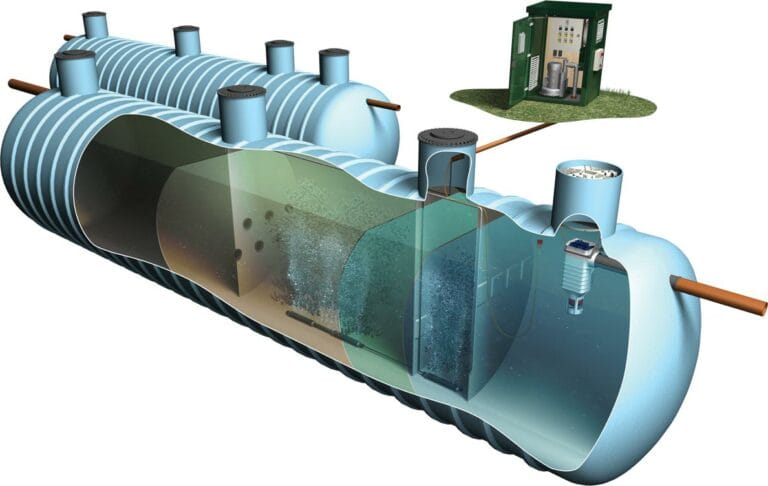
Most domestic systems follow a three-stage process:
1. Primary Settlement
Wastewater enters the first chamber, where solids sink to the bottom as sludge and fats and oils rise to the surface. Anaerobic bacteria begins breaking down the settled solids.
2. Aeration and biological treatment.
Clarified liquid passes into the aeration chamber. Here, a small air blower or compressor introduces oxygen, creating the right conditions for aerobic bacteria to grow on a specially designed bio-media. The bacteria consumes the dissolved pollutants and organic matter, dramatically reducing BOD (biochemical oxygen demand), suspended solids and ammonia.
3. Final settlement and discharge
Treated effluent flows into a final settlement chamber, where any remaining suspended material settles out. The clean effluent is then discharged, either by gravity or pump to a drainage field or watercourse.
UK Regulations: What the law requires in 2026
Understanding the regulatory framework is essential before specifying or installing any off-mains drainage system in England.
The General Binding Rules
The Environment Agencies General Binding Rules (GBR) for small sewage discharges govern how domestic sewage treatment plants and septic tanks can operate in England without requiring an individual environment permit. Under the current rules:
- Your system must treat domestic sewage only
- You must not exceed volume thresholds – 2m³ per day for discharges to ground, 5m³ per day for discharges to surface water
- Your system must be installed and operated in accordance with the manufacturer’s specification
- It must be properly maintained, including regular de-sludging
- The discharge must not cause pollution to surface water or groundwater.
If your discharge falls outside any of these conditions, you must apply for an environmental permit from the Environment Agency.
The 2020 rule change: what it means for septic tank owners
Since 1st January 2020, septic tanks can no longer legally discharge directly to a watercourse such as a steam, ditch, river or drain, This applies regardless of when the system was installed.
If you have an existing septic tank that discharges to surface water, you have three compliance routes.
- Replace or upgrade to a small sewage treatment plant certified to BS EN 12566-3.
- Divert the discharge to a drainage field designed to BS 6297:2007, subject to suitable ground conditions
- Connect to the public foul sewer, where one is reasonably accessible
For most rural homeowners and landlords, option 1, replacing the septic tank with a sewage treatment plant is the most practical route and the one the Environment Agency expects.
This obligation is also triggered when a property is sold. Agents and solicitors increasingly flag non-compliant systems during conveyancing and the buyers regularly require evidence of compliance as a condition of purchase.
BS EN 12566-3 Certification
Any new sewage treatment plant installed in England must be certified to BS EN 12566-3 (or the equivalent standard in force at the time of installation). This certification confirms the system has been independently tested and that the effluent quality meets national consent requirements.
All units in the Marsh Ensign range are tested and approved to BS EN 12566-3/A1:2009 with published test results of 11.5mg/l BOD, 19.2 mg/l suspended solids and 8.4 mg/l ammonia, well within the thresholds required for both ground and surface water discharge.
Building regulations and planning permission
Installing a new domestic sewage treatment plant requires building regulations approval. In most cases you will not usually need planning permission for a domestic installation but there are expectations, particularly in conservation areas, Areas of Outstanding Natural Beauty or near protected water sources. Always check with your local planning authority at the outset.
Septic Tank vs Sewage Treatment Plant: Which Do You Need?
| Septic Tank | Sewage Treatment Plant | |
|---|---|---|
| Discharge to drainage field | ✔ | ✔ |
| Discharge to watercourse | ✘ (illegal since 2020) | ✔ (subject to GBR compliance) |
| Active biological treatment | ✘ | ✔ |
| Requires electricity | ✘ | ✔ (usually) |
| Annual maintenance required | ✔ | ✔ |
| Effluent quality | Lower | Up to 97% pollutant removal |
| Suitable for rural plots with no drainage field | ✘ | ✔ |
For most new installations and upgrade projects, a sewage treatment plant is now the standard specification. It gives you greater flexibility on discharge point, higher effluent quality and full regulatory compliance.
Sizing a domestic sewage treatment plant
Getting the size right is critical. An undersized plant will be overloaded, performance will deteriorate and you may create a compliance problem. An oversized plant, though not harmful to the environment it represents unnecessary cost.
Population Equivalent (PE)
Domestic sewage treatment plants are sized in Population Equivalent (PE), which represents the number of people the system is designed to treat. The standard UK sizing rule, following British Water’s Flows and Loads guidance, is:
- Up to 4 bedrooms: 6 PE
- 5 bedrooms: 7 PE
- 6 bedrooms: 8 PE
- Each additional bedroom adds 1 PE
A 6PE unit such as the Marsh Ensign 6 is by far the most common size for single domestic dwellings.
Planning ahead for extensions
If you are planning a future extension, annex or additional bedroom, size the treatment plant to be for the ultimate occupancy now. Building Control will require this and retrospectively upgrading a system once it is installed is significantly more disruptive and expensive.
Multiple properties
For a small development of two or three properties sharing a system, a larger multi-unit configuration such as a 12PE or 16PE plant is typically more cost effective than individual systems for each plot. The Marsh Ensign range runs from 4PE to 50PE with larger populations available as multiple tank configurations making it suitable for small rural developments and private estates as well as single households.
The Marsh Ensign Range: An Overview
Marsh Industries is a leading UK manufacturer of domestic and small commercial off-mains drainage systems. The Ensign range is their flagship sewage treatment plant product line and it is widely regarded across the industry for it’s reliability and low long-term running costs.
CountyClean works with the Ensign range as our preferred specification for domestic sewage treatment plant installation across London, Kent, Sussex and the South East.
Ensign:Standard
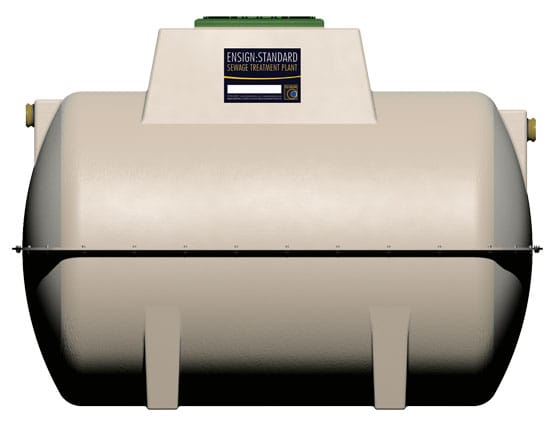
The Ensign:Standard is a robust, no-moving internal parts unit that covers the full domestic and small commercial range from 4PE to 50PE. It uses a fixed bio-media configuration with diffused aeration, delivering consistent treatment performance with minimal maintenance requirements. The absence of internal moving parts keeps long-term servicing costs low and reduces the risk of mechanical failure.
Key features:
- Certified to BS EN 12566-3/A1:2009
- 97% pollutant removal (published test results: 11.5 BOD / 19.2 SS / 8.4 ammonia mg/l)
- Low-energy compressor, suitable for internal or external housing
- Forsheda seal inlet and outlet for flexible installation
- 32mm sludge return to prevent blockages
- Integral lifting eyes and stablising feet for safe site handling
- Keying in lip for secure anchoring
Available in standard and shallow dig configurations
Ensign:Ultra
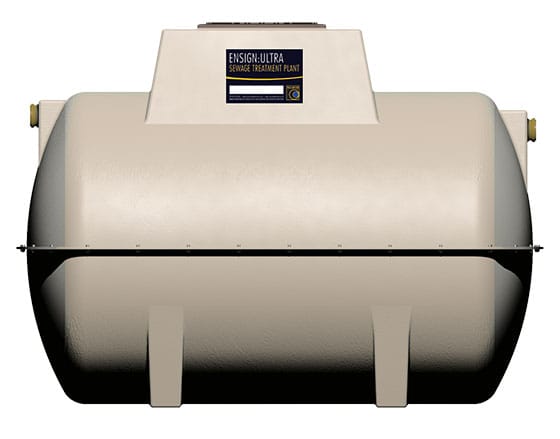
The Ensign:Ultra builds on the Standard specification with a series of enhancements designed to further reduce noise, improve treatment efficiency and extend drainage field life.
Additional features over the Standard:
- Near-siltent advanced compressor with integral low-pressure alarm
- RCD electrical connection for easier and safer installation
- Unique Polylok tertiary filter – reduces suspended solids and BOD up to a further 40% at the outlet stage, significantly extending the life of a drainage field and improving overall effluent quality
- Heavy duty impermeable lid and frame
- High-specification bio-media (310m ³ per m²) retained by stainless steel securing mesh
The Ensign:Ultra is the specification we recommend for sites with more sensitive discharge points, long or complex drainage field arrangements or where planning conditions require the highest available effluent quality.
Shallow dig variants
Both the Standard and Ultra are available in shallow dig configurations, covering 4PE to 35PE. These are designed for sites where ground conditions limit excavation depth, a common challenge in areas with high groundwater tables, rock or made-up ground. Shallow dig units are supplied as standard for 4PE models.
Why we specify the Ensign range
- UK manufacture. Ensign units are made in the UK to British Standards, with consistent quality control and readily available parts.
- Proven track record. The Ensign has been installed across thousands of UK properties and is consistently recommended by installers, merchants and end users.
- Installation flexibility. Pea-shingle surround in normal ground conditions, optional riser extensions for deeper invert requirements and internal or external compressor housing options make site adaptation straightforward.
- Siting guidance baked in. The Ensign is designed for installation at least 7 metres from a dwelling and 10 metres from a watercourse, in line with general guidance a clear specification that simplifies the planning conversion.
- Full technical support from CountyClean and Marsh Industries. BIM files, CAD drawings and detailed installation documentation are available from architects, engineers and specifiers.
Siting your sewage treatment plant
Good siting is important as good specification. A poorly sited plant creates access problems for maintenance, may not comply with regulatory setback requirements and can cause odour nuisance.
Key siting considerations:
- Minimum 7 metres from any dwelling – including your own property and your neighbours’.
- Minimum 10 metres from any watercourse – stream, ditch, drain or river.
- Minimum 50 metres from any well, spring or borehole used for drinking water or food production – and check for groundwater Source Protection Zones (SPZ1) using the Environment Agency’s Magic map tool.
- Accessible for maintenance. The plant will need annual servicing and periodic de-sludging by a tanker so an accessible route will be required for the tanker within a reasonable tanker hose distance.
- Avoiding ancient woodland and protected sites. Discharges within or close to Sites of Special Scientific Interest (SSSIs) cannot meet the General Binding Rules and will require an environmental permit.
Your drainage field or discharge point will also need to be positioned with the right setbacks, percolation text results and ground conditions. On a constrained site, a survey by a specialist drainage engineer at the outset will save significant time and cost.
The Installation Process: What to Expect
Step 1: Site survey and specification
A qualified drainage engineer visits the site to access ground conditions, existing drainage arrangements, available discharge options (drainage field or watercourse), and access. The survey informs the final specification; plant size, discharge route and whether a pumped outlet is required.
For upgrading and replacing an existing septic tank, this visit will also confirm whether the existing drainage field can be retained or whether it needs to be replaced.
Step 2: Building regulations notification
Before work begins, you need building regulations approval. Your installer or drainage engineer can typically manage this submission on your behalf for a fee.
Step 3: Excavation and installation
The installation process for a Marsh Ensign unit follows the manufacturer’s specifications:
- Excavation of the tank chamber and drainage field trenches
- Bedding in normal ground conditions, as pea-shingle surround and bed is all that is required. Concrete surround may be necessary in high groundwater conditions.
- Installation of the unit – lifting eyes allow safe positioning. The Ensign self-levels on its base.
- Connection of inlet and outlet pipework using flexible band seals.
- Compressor installation – internal or external housing depending on site preference and plant size, external is also recommended by CountyClean.
- Electrical connection – a local spur or mains connection for the blower, protected by an RCD.
- Drainage field installation – perforated pipe laid in gravel-filled trenches to BS 6297:2007 design. (percolation test must be done prior to install)
A typical single-dwelling installation takes between three and eight days depending on ground conditions and drainage field extent.
Step 4: Commissioning and sign-off
Once installed, the plant is commissioned and checked against the manufacturer’s specification. Building regulations sign-offs is obtained. You should receive a full set of documentation covering the installation, including the manufacturer’s manual, maintenance schedule and commissioning record.
CountyClean handles the full process, from the initial survey through to Building Control sign-off as a single managed service.
Running costs and maintenance
Electricity
A domestic sewage treatment plant requires a continuous electricity supply to run the aeration blower. For a 6PE Ensign: Standard unit, typical running costs are in the range of £80-£150 per year based on current average UK electricity rates. The Ensign: Ultra’s near silent advanced compressor is designed to minimise both energy consumption and noise.
Annual Servicing
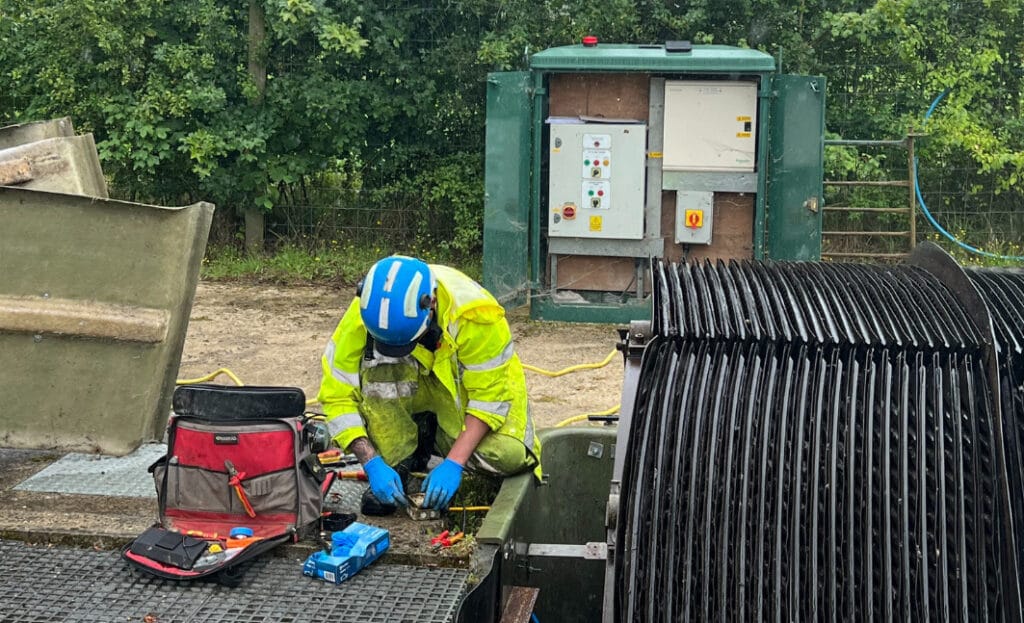
All sewage treatment plants require an annual service visit. This typically includes checking the blower and compressor, inspecting the bio-media, testing effluent quality and checking for unusual sludge build-up. Annual service costs for a domestic unit are typically in the £150-£250 range plus VAT.
De-sludging
The primary chamber accumulates settled sludge over time. This needs to be removed, typically once a year for a standard domestic household by a licensed liquid waste contractor using a vacuum tanker. CountyClean provides de-sludging services across London, Kent, Sussex and the South East as part of our vacuum tanker services.
Important: desludging must be carried out by a licensed waste carrier. Sludge from a sewage treatment plant is classified as controlled waste. Using an unlicensed operator is illegal and can result in significant fines.
What not to put down the drain
The biological process in a sewage treatment plant depends on the healthy bacterial populations. Certain household chemicals will kill or suppress bacteria, reducing treatment effectiveness and wet wipes can pile up and create blockages even when they are advertised as ‘flushable’. Learn more about the Bin the Wipe Campaign here. You should always avoid flushing or draining:
- Bleach, disinfectants and antibacterial cleaners in large quantities
- Medicines and antibiotics
- Nappies, wet wipes or sanitary volumes
- Strong chemical drain cleaners
Costs: What to budget
Costs vary depending on plant size, ground conditions, drainage field extent and access. The figures below are indicative for a standard single-dwelling installation in the South East of England. £9,500.00 – £25,000.00 (subject to works involved).
Replacing an existing septic tank where the drainage field is in good condition and can be retained will typically be at the lower end of this range. Sites with restricted access, high groundwater, rock or significant drainage field requirements will be at the higher end.
Who needs a domestic sewage treatment plant
Homeowners replacing a septic tank
If your septic tank currently discharges to a watercourse and you have not yet upgraded, you are non-compliant with the 2020 General Binding Rules. Enforcement risk increases every year and non-compliance will almost certainly be flagged when you sell. Upgrading now is both the legally correct action and financially sensible one.
Self builders and new developments
Any new property without access to the public foul sewer will require a sewage treatment plant from the outset. Planning and Building Control will require evidence that the drainage design complies with current standards.
Rural landlords
As a landlord, you carry responsibility for ensuring the sewage treatment system on your property is compliant, maintained and not causing pollution. A non-compliant or poorly maintained system can leave you personally liable for enforcement action by the Environment Agency.

Barn conversions and change of use
Converting an agricultural building or commercial property to residential use typically involves creating a new wastewater treatment system from scratch. A correctly specified sewage treatment plant is the standard approach.
Small rural developments
For developers working on small rural schemes, typically two to five plots, a shared sewage treatment plant on a larger Ensign unit is often more cost-effective and easier to manage than individual systems per plot.
Why choose CountyClean for your sewage treatment installation?
CountyClean Environmental Services is a specialist liquid waste and environmental services company operating across London, Kent, Sussex and the South East with nationwide project capability. As part of the Ipsum Group, we combine regional expertise with the resources and backing of a major national environmental services business.
We work with Marsh Industries and specifically the Ensign range because we have confidence in the product’s performance and reliability and because it makes our installations straight forward and the outcomes predictable for our clients.
Our sewage treatment plant installation service covers:
- Initial site survey and ground investigation
- Full scope and specification
- Building regulations application and management (if required)
- Excavation, installation and drainage field construction
- Commissioning and Building Control sign-off
- Ongoing maintenance, servicing and de-sludging
We also provide ongoing de-sludging and servicing for existing sewage treatment plants, whether originally installed by us or not.
If you are based in London, Kent, Sussex, or the surrounding South East region and are considering a new installation, replacement, or upgrade, get in touch with the CountyClean team for an initial conversation and site survey.
Frequently Asked Questions
A domestic sewage treatment plant is a self-contained underground system that treats wastewater from a property not connected to the mains sewer. It uses biological processes where aeration and bacteria typically grow on bio-media to produce treated effluent that is clean enough to discharge to a drainage field or in many cases, directly into a watercourse. Unlike a septic tank, a sewage treatment plant actively treats wastewater.
A septic tank separates solids from liquid but does not actively treat the wastewater. The liquid effluent still contains significant pollutants and must be discharged to a drainage field for further natural treatment. Septic tanks cannot legally discharge to a watercourse since January 2020.
A sewage treatment plant actively treats wastewater using aeration and biological processes, removing up to 97% of pollutants and the treated effluent can be discharged to a drainage field or directly to a watercourse, subject to compliance with the General Binding Rules.
In most cases, planning permission is not required for a domestic sewage treatment plant under permitted development rights.
However, building regulations approval is always required.
There are exceptions, particularly in conservation areas, Areas of Outstanding Natural Beauty or near protected bodies of water. Always contact and confirm with you local planning authority before work begins.
The General Binding Rules are conditions set by the Environment Agency that allow small sewage discharges to operate locally in England without a full environmental permit. They set volume limits, require the system to be properly maintained and require that the discharge does not cause pollution.
As long as your system meets all the applicable rule, your discharge is exempt from the permit requirement. If your system falls outside the rules, you must apply for an environmental permit.
In some cases, an existing septic tank can be adapted or supplemented to function as a sewage treatment plant, by adding an aeration unit. Whether this is appropriate depends on the condition and configuration of the existing tank.
In most cases, particularly where the tank is ageing or the site has changed, full replacement with a new packaged sewage treatment plant is more cost-effective and gives a clearer compliance outcome.
A typical single-dwelling installation involving excavating the tank chamber, installing the unit, connecting pipework, laying a new drainage field and commissioning takes between one and three days.
Larger more complex sites or sites requiring significant drainage field work may take longer. A pre-installation site survey with give a clearer timeline.
Most domestic sewage treatment plants require an annual service visit covering the blower, bio-media and effluent quality check. The primary chamber should be de-sludged (emptied) approximately once a year for a standard household.
Some systems and usage patterns may require more frequent attention. De-sludging must be carried out by a licensed liquid waste contractor, in all cases when buying a system it will come with manufactures guideline for maintenance.